Introduction:
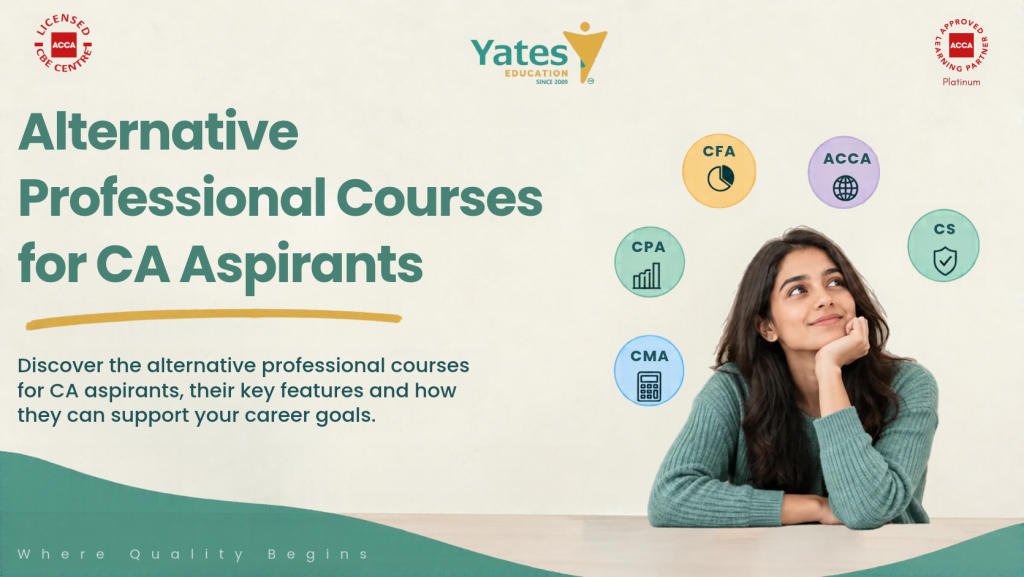
What if pursuing a career in finance and accounting does not necessarily mean following the CA path? While CA is a well-established qualification, it is far from being the only route to a successful career in this field. Today, several professional qualifications offer different learning paths, specialisations and career opportunities, some with a strong global presence. If you are a CA aspirant rethinking your options or looking for a qualification that better suits your interests and career goals, exploring alternative courses to CA could open up possibilities you may not have considered before.
In this blog, we will look at some of the most promising alternative courses to CA and what makes each of them worth considering.
1) ACCA (Association of Chartered Certified Accountants)
ACCA is one of the strongest alternative courses to CA for students who want to build a career in accounting and finance. It is a globally recognised professional qualification with a curriculum covering financial accounting, taxation, audit, financial management and business strategy. With recognition in over 180 countries, ACCA offers opportunities to build a career in India as well as international markets.
lass=”yoast-text-mark” />>
One of its biggest advantages is its flexible structure, with four exam sessions every year, on-demand exams for initial papers and exemptions for eligible students based on their previous qualifications. The qualification also allows students to choose specialisation papers according to their career interests. Its paper-wise pass rates also give students a clearer picture of the examination requirements and preparation involved.
2.US CMA (Certified Management Accountant)
<span style=”font-weight: 400;”>Offered by the Institute of Management Accountants (IMA), the US CMA focuses on management accounting, financial planning, performance analysis, risk management and strategic decision-making. It suits students interested in corporate finance, budgeting and financial planning and analysis (FP&A).
3.US CPA (Certified Public Accountant)
The US CPA is a professional accounting qualification associated with accounting and licensing in the United States. It covers financial reporting, auditing, taxation and business analysis, making it suitable for students interested in US accounting practices and finance roles involving US reporting requirements.
4.CFA (Chartered Financial Analyst)
Offered by CFA Institute, the CFA programme focuses on investment analysis, portfolio management, financial markets and asset valuation. It suits students interested in investment research, asset management and portfolio analysis.
5.CS (Company Secretary)
<span style=”font-weight: 400;”>The CS qualification, offered by the Institute of Company Secretaries of India (ICSI), focuses on corporate law, governance, regulatory compliance and company administration. It suits students interested in corporate compliance, governance and advisory roles.
6.CMA India (Cost and Management Accountant)
<span style=”font-weight: 400;”>Offered by the Institute of Cost Accountants of India (ICMAI), CMA India focuses on cost accounting, cost control, budgeting, financial planning and performance management, preparing students for roles in cost and management accounting and financial planning across industries.
| Course | Core focus | Eligibility to start | Scope |
|---|---|---|---|
| ACCA
(ACCA Global) |
Accounting, audit, tax, financial reporting, management accounting and business strategy. | Students can start ACCA after Class 10 through the Foundation route, or after Class 12 through the standard entry route. Graduates and CA qualified professionals can also begin, and may be eligible for exemptions based on their earlier studies. | <span style=”font-weight: 400;”>ACCA offers a wide scope in India and across 180 countries, with career opportunities in accounting, audit, taxation, financial reporting and management at Big 4 firms, MNCs, banks and consulting firms. |
| US CMA
(IMA) |
Management accounting, planning and performance | Graduates and final-year students can start the US CMA by joining IMA and enrolling in the CMA program. | <span style=”font-weight: 400;”>The US CMA offers a scope in India and few other countries, with career opportunities in management accounting, financial planning and analysis (FP&A), budgeting, cost management and corporate finance at MNCs, corporates and banks. |
| US CPA
(State boards, US) |
US accounting, audit and taxation | <span style=”font-weight: 400;”>Students can start the US CPA with a bachelor’s degree (around 120 credit hours) in most states, while 150 credit hours and 1 to 2 years of experience are usually needed for licensure. | <span style=”font-weight: 400;”>The US CPA offers scope mainly in accounting, audit and taxation roles that involve US reporting standards, at firms and multinational companies that work with US clients. |
| CFA
(CFA Institute) |
Investment analysis and portfolio management | <span style=”font-weight: 400;”>Students can start the CFA with a bachelor’s degree, while in the final stage of their degree, or through 4,000 hours of work experience and/or higher education. | <span style=”font-weight: 400;”>The CFA offers scope mainly in investment-focused roles such as equity research, portfolio management, asset management and risk analysis at investment firms, banks and wealth management companies. |
| CS
(ICSI) |
Corporate law, governance and compliance | Students can start the CS course after Class 12 by clearing the CSEET entrance test. Graduates may also enter, subject to ICSI’s current rules. | <span style=”font-weight: 400;”>The CS course offers scope in India in corporate governance, compliance, company law and secretarial roles at companies and listed firms. |
| CMA India
(ICMAI) |
Cost and management accounting | <span style=”font-weight: 400;”>Students can register for CMA Foundation after Class 10 and appear for the exam after Class 12, while graduates can enter directly at the Intermediate level. | <span style=”font-weight: 400;”>The CMA India course offers scope in cost and management accounting, cost audit, budgeting and financial planning across industries in India. |
How to Choose the Right Course:
- Build on Your Existing Knowledge –
Your CA preparation has already introduced you to important concepts in accounting, taxation and finance. Look for a qualification that builds on this knowledge while helping you develop new skills instead of making you start from scratch.
- Consider Global Recognition –
If you wish to explore opportunities beyond India, consider qualifications that are recognised internationally. Some professional courses offer access to a wider job market, allowing you to explore career opportunities across different countries and industries.
- Pick a path that fits your pace –
<span style=”font-weight: 400;”>Choose a course that matches the time and energy you can give, so you can stay consistent from start to finish.
- Consider Learning and Placement Support –
Moving to a new qualification can bring its own challenges. Look for an institute that offers experienced faculty, regular mock tests, personal guidance and placement assistance to help you prepare for your professional career.
Why ACCA Stands Out:
Among the alternative courses to CA, ACCA stands out for its global recognition, flexibility and career opportunities. While CA focuses on the Indian accounting framework, ACCA offers an international perspective through subjects like financial reporting, audit, taxation, financial management and business strategy. Recognised across 180+ countries, it offers career opportunities in India and abroad. Its flexible structure includes four exam sessions annually, on-demand exams for certain papers and exemptions based on previous qualifications. Students can also choose specialisation papers according to their interests. With a focus on professional ethics, practical work experience and industry-relevant skills, ACCA is a strong option for CA aspirants seeking international career opportunities.
Conclusion:
<span style=”font-weight: 400;”>Here at Yates Education, over the years we have seen many students make the leap from CA to ACCA and the ones who feel most confident are those who understood their options before they decided. Choosing among the alternative courses to CA is a big decision, and you shouldn’t have to make it alone. Our team guides students through how the ACCA pathway works, which papers they may be eligible to skip and how to plan their studies, so the switch feels clear and manageable.
Frequently Asked Questions:
1.Can I move to ACCA if I am preparing for CA?
Yes. ACCA can be started after Class 10, Class 12 or graduation, so you can join at the stage that suits you. Exemptions depend on your earlier qualifications, and you can check them on ACCA’s website.
2.Is ACCA easier than CA?
ACCA and CA have different examination structures and syllabuses, so directly comparing their difficulty is not fair. ACCA offers flexible exam scheduling, but its papers still require consistent preparation and a strong understanding of concepts.
3.Can I pursue ACCA while working or studying in college?
Yes. ACCA offers flexible exam sessions and on-demand exams for certain papers, making it possible to balance studies with college or work commitments.